
SPH Faculty and Students Present Cancer Research at AACR Annual Meeting
Last month, faculty and doctoral scholars from the OHSU‑PSU School of Public Health shared cancer prevention and screening research at the American Association for Cancer Research (AACR) Annual Meeting, held in San Diego, California. The AACR Annual Meeting is one of the world’s largest gatherings of cancer researchers, clinicians, and public health professionals, offering a global stage for cutting-edge scientific exchange.
Examining Bias in Breast Cancer Screening
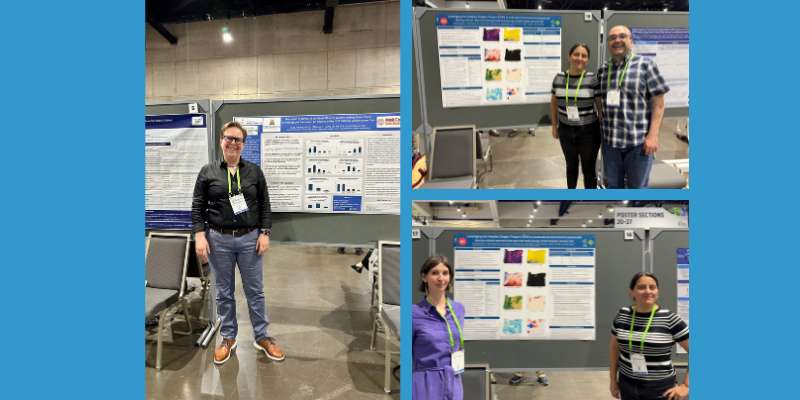
Cesar Cristancho Rojas, a third‑year PhD candidate in the Epidemiology program, presented his poster titled “Screening Biases: The Case of Mammography for Breast Cancer.” This work, co-authored with Sofia Chapela Lara, Lynne Messer, and Kristi Tredway, examines how three foundational screening biases—lead‑time bias, length‑biased sampling, and overdiagnosis—are acknowledged and addressed in breast cancer mammography research.
Through a systematic review of more than 3,600 studies evaluating mammography screening, Cristancho Rojas found that fewer than 5% explicitly mentioned any of these biases. Their analysis reviewed the subset of studies that did identify or characterize these biases, assessing how often they were formally addressed and what methods were used to estimate or correct for their effects.
Environmental Exposures and Young‑Onset Breast Cancer
Sofia Chapela Lara, an Environmental Systems and Human Health Postdoctoral Fellow, presented a poster introducing ongoing research into the potential links between environmental exposures and young‑onset breast cancer. Using data from the Healthy Oregon Project (HOP)—an Oregon‑based cohort coordinated by the OHSU Knight Cancer Institute—the project lays the groundwork for examining how environmental conditions during key reproductive periods may influence breast cancer risk.
The poster mapped the geographic distribution of several climate, environmental, and social factors across Oregon, including air pollution, wildfire smoke exposure, temperature, burn areas, land use, pesticide use, and neighborhood vulnerability. These patterns were shown alongside county‑level distributions of young‑onset breast cancer. Future analyses will assess the environment around individual participant’s residential addresses
Greenspace and Ovarian Cancer Survival
Charlotte Roscoe, Assistant Professor of Environmental Systems and Human Health, presented a poster on research she co‑authored as senior author, alongside Professor Shelley Tworoger, with Dr. Jaileene Perez‑Morales as first author. The study examined greenspace exposure and ovarian cancer survival using data from the Nurses’ Health Study (NHS) and NHSII cohorts. Greenness around residential address was suggestively associated with ovarian cancer survival and further analyses by histotype are planned.
COVID‑19, Telehealth, and Screening Access for Sexual Minority Women
Kristi Tredway, Assistant Professor in Epidemiology, presented a poster titled “The Impact of COVID‑19 on Sexual Minority Women Seeking Breast Cancer Screenings and Treatment.” Drawing on data from the National LGBT Cancer Network, the research, co-authored with Melissa S. Camp at Johns Hopkins University and Vered Stearns at Weill Cornell University, examined how disruptions during the COVID‑19 pandemic affected access to care, patient experiences, and emotional well‑being.
Tredway noted that she had hoped to observe overwhelmingly positive experiences with telehealth, given its potential to connect patients with specialized oncology care regardless of location, which the data did show. The data also revealed significant challenges that emerged during the COVID-19 era. These included delays in screening and treatment, which can worsen cancer staging and complicate care, as well as restrictions that prevented patients from having partners, family members, or other support people present during appointments.
“These barriers significantly increased anxiety during an already stressful diagnosis,” Tredway said. The findings also highlight the importance of telehealth access in oncology, particularly as many pandemic‑era licensure flexibilities allowing cross‑state telehealth services have since expired.
Advancing Cancer Research Through Public Health
Collectively, these presentations reflect the School of Public Health’s commitment to rigorous cancer prevention and control research, interdisciplinary collaboration, and health equity. From improving cancer screening methodology to understanding environmental and social drivers of cancer risk and survival, SPH faculty and students continue to advance research that informs policy, practice, and patient outcomes.