
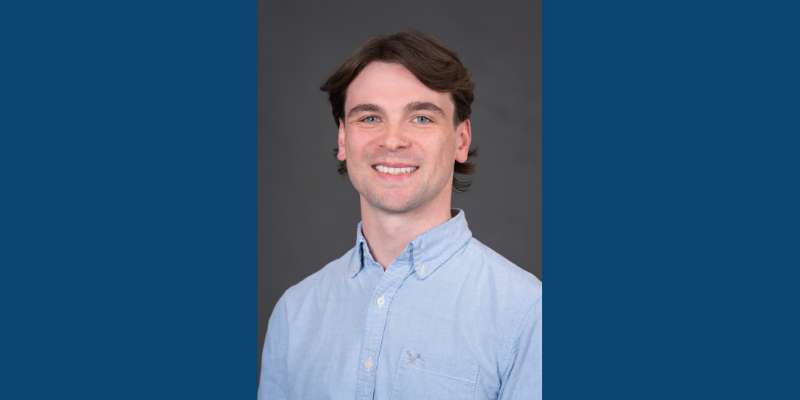
Graduate Spotlight: Riley Tindell
Riley Tindell pursued a Master’s in Public Health (MPH) in Environmental Systems and Human Health because he wanted to build a career centered on supporting and uplifting his community during a time of growing uncertainty. From climate change to advances in artificial intelligence and ongoing political challenges, Riley recognized the importance of contributing to solutions that protect and strengthen communities at a local level.
“There’s so much uncertainty in the world right now,” Riley said. “I realized that while I’m probably not going to solve these issues on a global scale, I couldn’t just sit back and be idle.”
Throughout the program, Riley became increasingly drawn to the broad and interconnected nature of public health. He appreciated how the field influences nearly every aspect of daily life, including workplaces, housing, transportation, and environmental conditions such as air and water quality.
“Public health plays a role in nearly every aspect of our lives,” he said. “There are so many opportunities to make a lasting impact, and you can really decide which issues matter most to you and carve out your own path.”
One of Riley’s most meaningful academic experiences came through coursework in Ecological Public Health, where he conducted a health impact assessment examining the potential effects of data centers on a local community. At the same time, Oregon’s Data Center Advisory Committee was addressing many of the same concerns in real-world policy discussions, reinforcing for Riley how practical and relevant public health work can be.
“It helped me realize that the most meaningful contributions in public health don’t always have to be the most visible ones,” he said. “Sometimes it’s just conducting research that reaches the right people at the right moment to create change.”
Like many graduate students, Riley faced challenges balancing academics, work, finances, and personal life throughout the program. He shared that managing the demands of graduate school required more time and energy than he initially anticipated, especially while also navigating financial stressors.
“Grad school is not cheap,” Riley said. “There were moments where it felt like something else would always go wrong, and that definitely added to the anxiety I was already experiencing.”
Riley credits much of his inspiration throughout graduate school to the people around him. He found motivation in classmates from diverse backgrounds, alumni who returned to share their professional experiences, and the many examples of impactful public health work taking place beyond the classroom.
He also credits his partner, Ella, as one of his greatest sources of encouragement and support.
“She was with me every step of the way and always provided assurance that got me through difficult times,” Riley said. “She also made sure I took breaks and made time for myself outside of school.”
In addition to support from family and friends, Riley highlighted the role his advisor, Tawnya, played throughout his academic journey by consistently checking in and helping him navigate challenges as they arose.
Following graduation, Riley plans to enter the workforce and apply the skills and knowledge he developed during the program in a professional setting. Although he is still exploring opportunities, he hopes to begin a career in environmental health and safety, focusing on protecting workers and addressing systemic barriers that contribute to health inequities.
“Work is such a significant determinant of health,” he said. “It shapes our financial stability, stress levels, exposure to hazards, and overall well-being. Worker health is very personal to me. My grandpa passed away when I was young from Mesothelioma after working in shipyards for much of his life, so I want to be in a position to prevent outcomes like that.”
Looking ahead, Riley hopes to help create healthier and safer workplace environments through compliance work, exposure assessments, and fostering positive safety cultures where workers feel valued and protected.