
Bridging the Rural Divide: How the OHSU-PSU School of Public Health Is Leveraging Legislative Investment to Build Oregon’s Health Workforce
As public health challenges in rural Oregon grow increasingly complex, academic institutions and community leaders are redefining how to prepare, train, and retain the workforce needed to meet them. At the 43rd Annual Oregon Rural Health Conference in Bend, leaders and practice partners from the OHSU-PSU School of Public Health (SPH) presented actionable strategies for transforming rural public health training through state investment, collaborative curriculum co-design, and expanded educational pathways.
The session focused on how SPH is maximizing funding from the Oregon Legislature’s OHSU 30-30-30 Plan—a statewide effort aimed at expanding Oregon’s healthcare and public health workforce capacity. By translating this legislative investment into targeted initiatives, SPH is actively strengthening reciprocal linkages with rural practice partners and reducing systemic barriers for rural students.
Breaking Down Barriers to Rural Public Health Education
A central pillar of the discussion was expanding access for rural learners. Traditional graduate-level public health programs often require students to relocate to urban centers, creating geographic and economic hurdles that disproportionately affect rural applicants.
Through the 30-30-30 funding, SPH is working to enhance access to financial support, streamline enrollment pathways, and provide flexible, accessible support structures designed to retain students within their home communities.
“Advancing health equity in rural Oregon requires a workforce rooted in the communities it serves,” said Dawn Richardson, DrPH, MPH, Executive Associate Dean and Professor at the OHSU-PSU School of Public Health. “By reducing financial and geographic barriers to graduate public health education, we can ensure that local knowledge and lived experience guide health initiatives across the state.”
“What would it actually take to grow and diversify Oregon’s public health workforce, not simply by enrolling more students, but by changing the conditions that determine WHO can get a public health education, WHERE they can get it, and WHETHER that education prepares them for the communities where they will ultimately work? That is especially important when we think about rural and frontier Oregon”, said Dawn Richardson, DrPH, MPH, Executive Associate Dean and Professor at the OHSU-PSU School of Public Health.
Co-Designing Curriculum with Practice Leaders
Unlike traditional academic models where coursework is developed independently of local field realities, SPH’s implementation strategy centers on direct collaboration with governmental public health agencies and practice leadership.
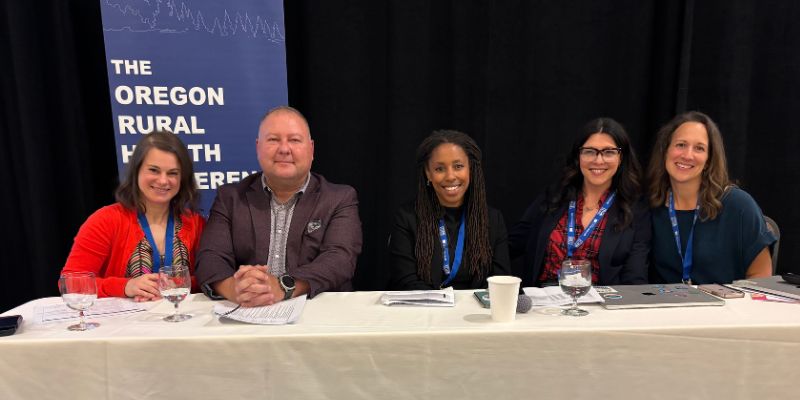
Panelists highlighted how rural workforce partners are directly engaged in curriculum development to ensure training aligns with real-world community needs. The panel featured perspectives across academic leadership, field education coordination, and local public health administration:
- Dawn Richardson, DrPH, MPH | Senior Associate Dean & Associate Professor, OHSU-PSU School of Public Health
- Alice Gates, MSW, PhD | Director of Rural Public Health Workforce, OHSU-PSU School of Public Health
- Cimone Campbell, MSW, LCSW | Assistant Dean of Enrollment Management, OHSU-PSU School of Public Health
- Timothy Lynch, DrPH, MHA | Public Health Director, Coos Health & Wellness
- Becky Jungbauer, DrPH, MPH, MA | Assistant Professor & Program Director, OHSU-PSU School of Public Health
Speaking from the practice perspective, Timothy Lynch, DrPH, MHA, Public Health Director at Coos Health & Wellness, emphasized the value of aligning academic instruction with local agency operations. “When academic institutions work alongside local health departments to shape coursework and practical field placements, students enter the field ready to make an immediate impact on community outcomes.”
Early Implementation Lessons and Sustainable Pathways
During the interactive presentation, the panel shared early operational insights for higher education and healthcare organizations seeking to establish sustainable workforce pipelines:
- Reciprocal Partnerships: Building a structure for partnerships that ensures mutual benefit, combining academic research and student support with local agency domain expertise.
- Tailored Support Systems: Implementing student success mindsets that cater to non-traditional and remote learners navigating work, study, and rural practice realities.
- Workforce Alignment: Regularly evaluating and updating curricula to match shifting workforce trends and rural health priorities.
As Oregon continues to address healthcare shortages, the collaboration between SPH, local health authorities, and the Oregon Office of Rural Health serves as a scalable model for state-funded workforce development. By connecting legislative funding directly to community-guided practice, the joint school aims to elevate population health outcomes across all 36 Oregon counties.