
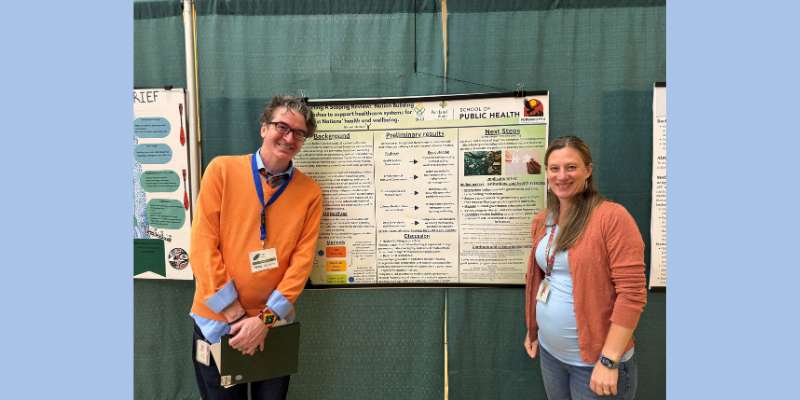
Assistant Professor Kathleen Conte of the OHSU-PSU School of Public Health has co-authored a new publication examining critical gaps in public health data access for Tribal communities. The article, “Examining Data Access Gaps for Tribal Epidemiology Centers: Qualitative Interviews and a 50-State Syphilis Data Audit,” highlights the barriers American Indian and Alaska Native Tribes and Tribal Epidemiology Centers face in obtaining data they have a legal right to access. Through qualitative interviews and a nationwide audit, the study reveals that only a small number of states provide timely, useful syphilis surveillance data, while many states rely on information that is outdated or incomplete, creating limitations that can hinder effective public health decision-making.
The findings underscore the importance of equitable, transparent data sharing to support Tribal public health efforts. When access is restricted or delayed, Tribal health organizations may be forced to rely on limited or outdated information to guide interventions. The study also reflects meaningful student collaboration, with OHSU-PSU School of Public Health MPH student Levi Mattoon contributing to the research as part of his FORWARD internship, an internship cohort of select undergraduate students designed to prepare them to address healthcare disparities and improving equity for Indigenous communities, including Native American, Alaska Native, Native Hawaiian, Pacific Islander, First Nations (Indigenous to Canada), and Indigenous peoples of Mexico, Central, or South America.
Through a partnership between Portland State University (PSU) and the Northwest Native American Center of Excellence (NNACoE) at OHSU, FORWARD offers a holistic 15-month multi-tiered mentorship and culturally responsive clinical internship where students build the skills, connections, and knowledge necessary to pursue advanced degrees in health professions.
“Having the honor and privilege of being selected for the ForwardPSU internship and working with Dr. Conte for the past year has been an incredible and life-changing experience. When I received notice that our research was being accepted for publication, it felt like the perfect way to cap off my undergraduate experience and transition into my Post-Bac MPH program. I was able to gain valuable learning experiences and new skillsets that I will undoubtedly use for years to come. I will be forever grateful for this opportunity.” says Levi
Together, Dr. Conte and Mattoon call attention to the urgent need for improved data access practices to better support Tribal sovereignty and health outcomes.